


Electrode Reactions, Impurity Pathways, Anode Passivation and Cathode Quality Control
1. Overview of Copper Electrorefining
Fire refining of copper generally produces blister copper containing 99.0%–99.8% Cu. In electrorefining, this copper is cast into anode plates and arranged alternately with permanent stainless-steel cathode plates in electrolytic cells filled with an aqueous solution of copper sulfate and sulfuric acid. Under direct current, copper and the less-noble metals dissolve from the anode into the electrolyte, while precious metals together with selenium and tellurium remain undissolved and settle at the cell bottom as anode slime.
Copper in the solution deposits preferentially on the cathode, whereas the less-noble metals cannot discharge there; they stay in the electrolyte until periodic purification removes them. The copper deposited on the cathode is of very high purity and is known as cathode copper or electrolytic copper; material containing 99.9935% Cu or more is classed as high-purity cathode copper.
A plant usually contains hundreds or even thousands of cells, with each DC power source connecting a number of cells in series as one system. The electrolyte must circulate continuously to keep its composition uniform, and the circulation system includes heaters that maintain the operating temperature.
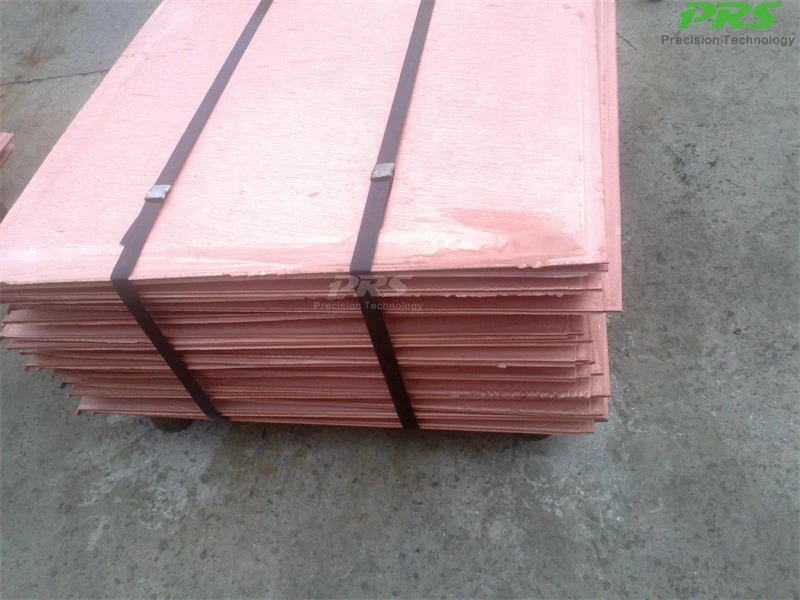
Fig. 1 High-purity cathode copper
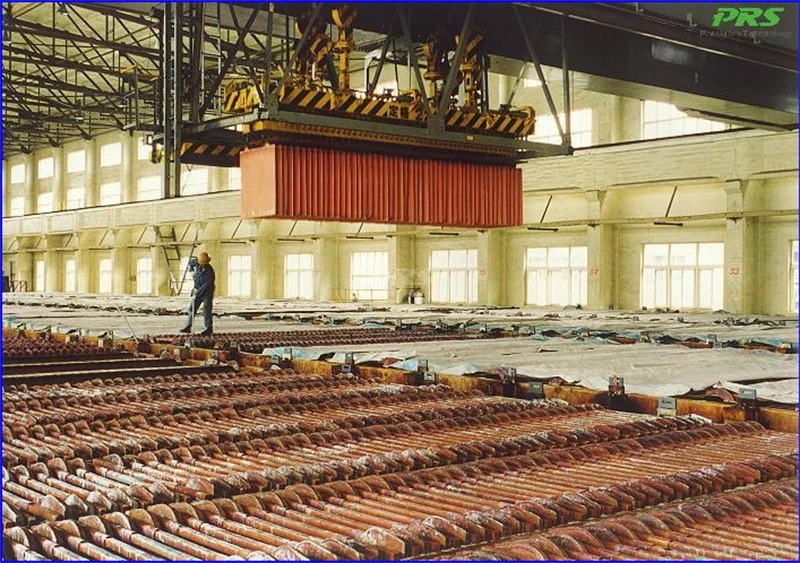
Fig. 2 Copper electrolytic plant in operation
2. Electrode Reactions and the Electrolyte
2.1 Electrode reactions
Anode copper contains a small amount of impurities (generally 0.3%–1.5%), and the electrolyte is mainly a copper sulfate solution with free sulfuric acid.
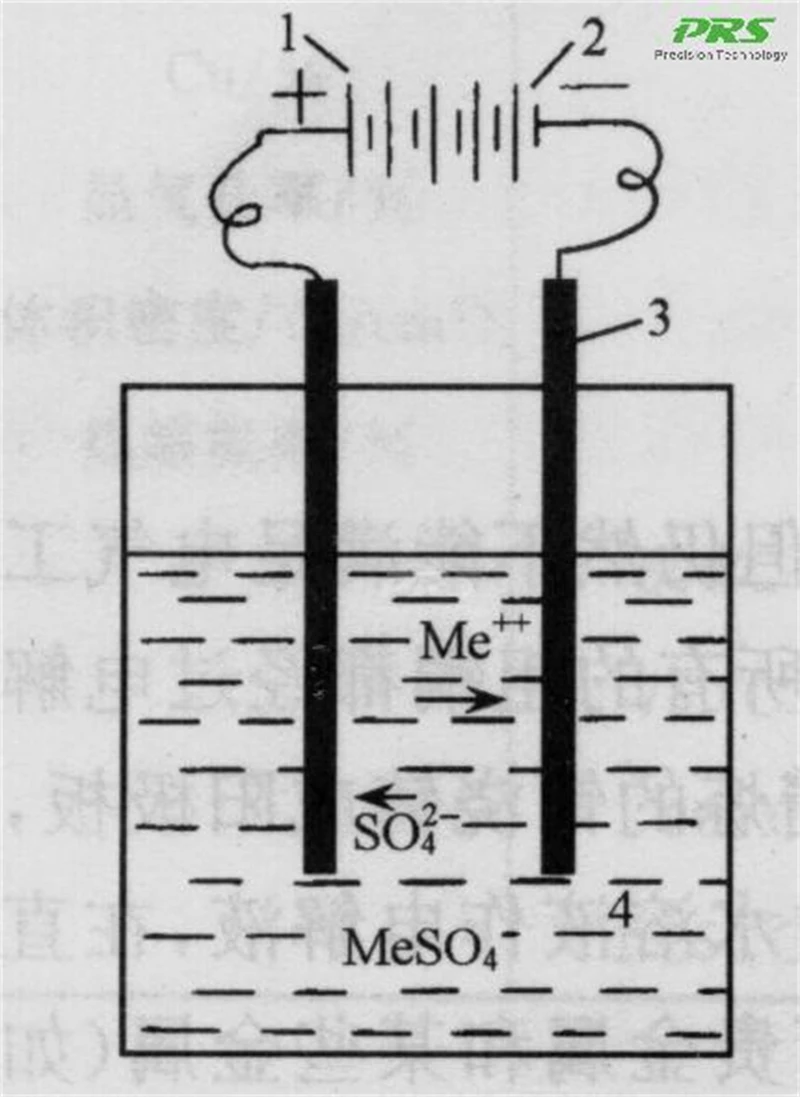
Fig. 3 Schematic of the process: 1-anode; 2-cathode; 3-conducting bar; 4-aqueous CuSO₄ and H₂SO₄ solution
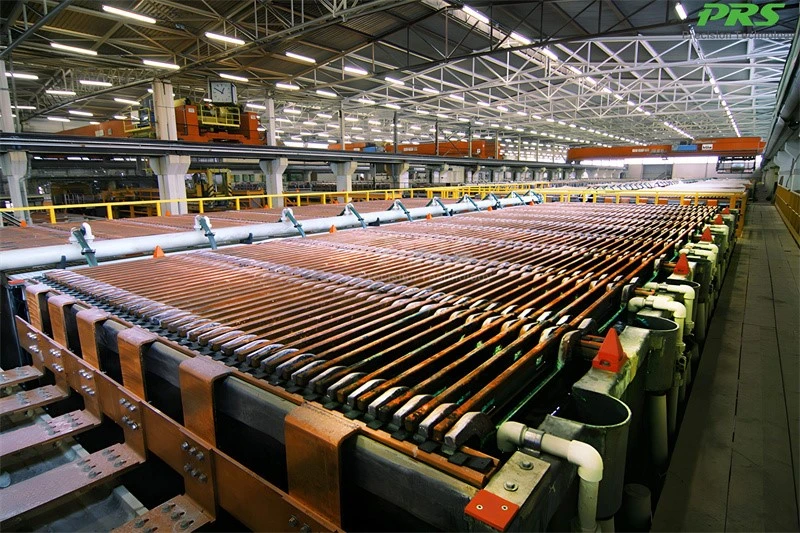
Fig. 4 Anodes and cathodes hung alternately in a cell, with copper bus bars on top
Through ionization, the electrolyte components form ions by the following reactions:
CuSO₄ = Cu²⁺ + SO₄²⁻ (1-1)
H₂SO₄ = 2H⁺ + SO₄²⁻ (1-2)
H₂O = H⁺ + OH⁻ (1-3)
Before current is applied these reactions are in dynamic equilibrium; when direct current passes through the electrodes and solution, the ions move directionally. The following reactions may occur at the anode:
Cu − 2e = Cu²⁺, E⁰(Cu²⁺/Cu) = +0.34 V (1-4)
H₂O − 2e = 1/2 O₂ + 2H⁺, E⁰(O₂/H₂O) = +1.23 V (1-5)
SO₄²⁻ − 2e = SO₃ + 1/2 O₂, E⁰(O₂/SO₄²⁻) = +2.42 V (1-6)
The standard potentials of H₂O and SO₄²⁻ are very high, so under normal conditions neither can discharge on the copper anode. Oxygen evolution also carries a large overvoltage, so reaction (1-5) does not occur. Oxygen can evolve only when the copper-ion concentration is extremely high, or when severe anode passivation raises the cell voltage above 1.7 V. SO₄²⁻ has an even more positive potential and cannot discharge in copper electrorefining.
The following reactions may occur at the cathode:
Cu²⁺ + 2e = Cu, E⁰(Cu²⁺/Cu) = +0.34 V (1-7)
2H⁺ + 2e = H₂, E⁰(H⁺/H₂) = 0 V (1-8)
Copper deposits at a more positive potential than hydrogen, and hydrogen has a large overvoltage on copper. Hydrogen can therefore evolve only when the copper-ion concentration near the cathode is extremely low and excessive current density causes severe concentration polarization.
The essence of electrorefining is thus copper dissolving anodically as Cu²⁺ after losing electrons and depositing cathodically as metallic copper after gaining them. Cu⁺ is inevitably formed as well and triggers a series of side reactions that complicate the process.
2.2 Selection and composition of the electrolyte
The sulfuric acid system is chosen because it conducts electricity well, evaporates little and is stable, allowing operation at higher temperature and acidity. Copper sulfate has a low decomposition voltage; arsenic, antimony and lead form sparingly soluble compounds in sulfuric acid, so impurities affect cathode quality less; and precious metals are separated almost completely.
The composition depends on the anode, current density and the required cathode quality, and differs between plants. Typical values are 40–55 g/L Cu present as CuSO₄ and 100–200 g/L H₂SO₄.
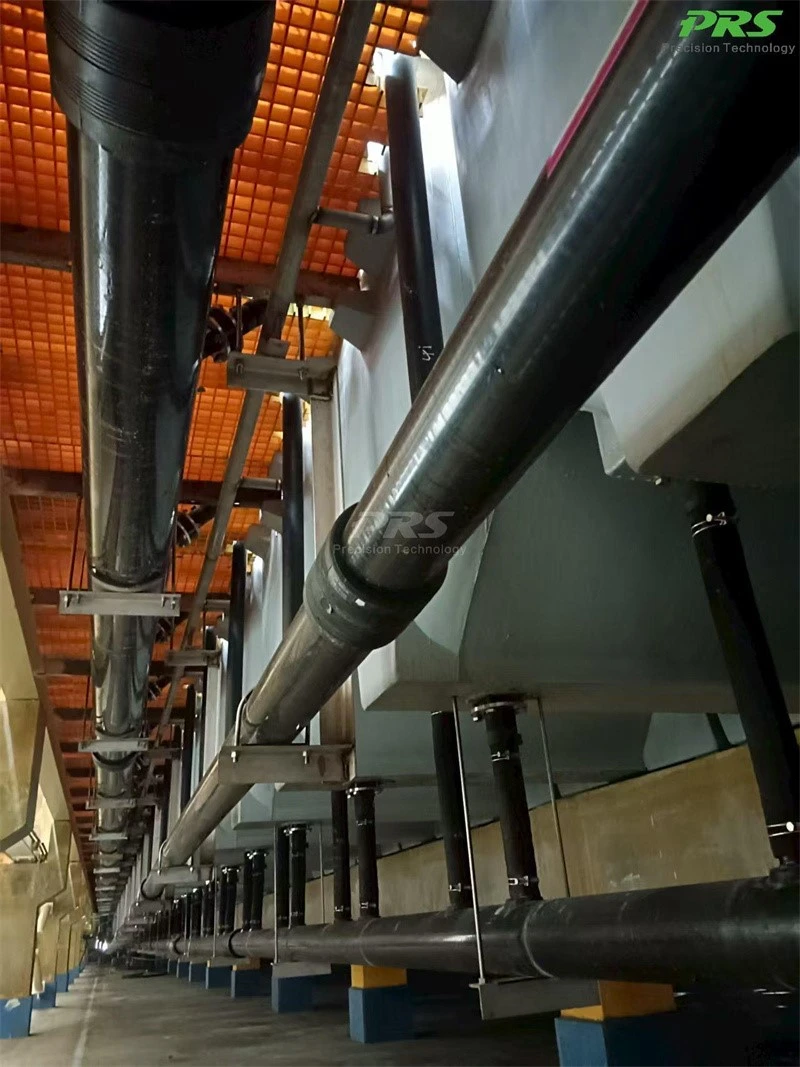
Fig. 5 Cell rows with electrolyte feed and circulation piping
A chloride concentration of 15–60 mg/L is maintained to lower the silver-ion concentration so that silver cannot discharge and be lost, to suppress the activity of As, Sb and Bi ions, and to eliminate anode passivation. Surface-active additives such as glue and thiourea are also added to prevent nodules and dendritic growth and to obtain a dense, smooth cathode; because they raise viscosity, the dosage depends on each plant's conditions.
3. Where the Impurities Go
Anode copper is an alloy containing many elements. By their potential relative to copper, the impurities fall into four groups: significantly more negative than copper (zinc, iron, tin, lead, cobalt, nickel); significantly more positive (silver, gold and the platinum group); close to but slightly more negative than copper (arsenic, antimony, bismuth); and others such as oxygen, sulfur, selenium, tellurium and silicon.
During electrolysis the impurities have only three destinations: they remain in the electrolyte, enter the anode slime, or contaminate the cathode in small amounts. These three pathways are precisely why electrorefining purifies copper.
Impurities more negative than copper dissolve anodically as divalent ions. Their potentials are far below that of copper, so they cannot deposit on the cathode of the same cell and simply accumulate in the electrolyte; their common effects are to consume sulfuric acid, raise the resistance and density of the electrolyte and slow the settling of anode slime. Lead and tin form sparingly soluble salts or oxides and pass largely into the anode slime.
Silver, gold and the platinum-group metals hardly dissolve and pass almost entirely into the anode slime, with gold close to 100%; the traces of gold in cathode copper come from mechanical entrainment of slime. Maintaining a certain chloride concentration forms silver chloride and reduces silver losses.
Arsenic, antimony and bismuth have potentials close to copper and are difficult to deposit under normal operation: part hydrolyses into solid oxides that enter the slime, part accumulates in the electrolyte. Trivalent arsenic with pentavalent antimony, and trivalent antimony with pentavalent arsenic, form sparingly soluble flocs generally finer than 10 μm that settle poorly and constitute floating anode slime. It adheres mechanically to the cathode or is occluded between copper grains, lowering cathode quality, and also scales the circulation piping.
4. Anode Passivation and Concentration Polarization
4.1 Anode passivation
Passivation means losing activity. In electrolysis, metal passivation refers to the electrode metal losing, to some degree, its ability to transfer into solution under current. A passivated electrode no longer shows its inherent potential but approaches that of a more electropositive metal; chemically, it loses its ability to be oxidized and especially to dissolve.
According to the phase-film theory, the films formed under copper electrorefining conditions fall into two categories:
(1) During anode dissolution, insoluble salts, more electropositive metals and insoluble oxides originating from the anode itself form a thin film that isolates the anode from the electrolyte and passivates it;
(2) Copper sulfate crystallizes out because of concentration polarization and covers the anode surface, causing passivation.
The two may occur separately or together; the amount and adsorption behaviour of anode slime strongly affect the first type of film.
4.2 Concentration polarization
In intensified operation, concentration polarization is the main cause of anode passivation. When Cu²⁺ in the anode compartment reaches saturation or supersaturation, copper sulfate deposits on the anode surface, blocking the anode reaction, raising the anode potential and preventing H⁺ from reaching the interior of the deposit.
In addition, Cu₂O in the anode reacts with H₂SO₄ to form copper powder and Cu²⁺, raising the copper concentration while consuming acid; the spongy powder covers the anode and raises its potential. The pH of the anode compartment rises, and once it exceeds 3.9 the system enters the CuO–Cu₂O stability field and passivates.
Passivation caused by concentration polarization is closely related to ion diffusion. Raising the electrolyte temperature, increasing circulation, lowering the impurity content and moderately reducing the Cu²⁺ concentration all lower viscosity, which raises the diffusion rate of Cu²⁺ and allows higher current density without passivation.
Measures against anode passivation
(1) Remove impurities as far as possible during fire refining;
(2) Control a suitable anode casting temperature to reduce dissolved gas and make the grain structure consistent between edges and centre;
(3) Maintain a reasonable electrolyte composition and temperature;
(4) Increase the electrolyte circulation rate appropriately and choose an effective circulation pattern;
(5) Use activators such as Cl⁻ and new additives; EDTA, for instance, gives the best inhibition at a concentration of about 0.5%;
(6) Apply moderate vibration to the electrodes to break up the oxide layer, the copper sulfate film or the copper powder covering.
5. Electrocrystallization and Cathode Quality
Electrocrystallization covers the whole sequence from cations discharging at the cathode and forming free atoms and crystal nuclei, to the build-up of crystals and the formation of a metal layer on the cathode surface. Nuclei grow at a certain rate and are generated and propagated periodically across each face of the thin metal layer; as new planar nuclei form, a metal layer develops at the interface.
The coarseness of metal deposited from simple salt solutions falls into three classes according to exchange current density or overvoltage. Copper belongs to the second class: an overvoltage of several tens of millivolts, an exchange current density of i₀ ≈ 0.1 A/m², and grains not exceeding 10 μm.
Copper-ion discharge at the cathode is under mixed control, governed jointly by concentration polarization and electrochemical polarization. Plotting the polarization curve as η = a + b·lg i gives curve ABC (Fig. 4). Segment AB is the Tafel line, dominated by electrochemical polarization, where electrolysis at the corresponding current density yields a dense product; segment BC is an arc, the mixed-control region, where a concentration gradient exists and the deposit is not dense.
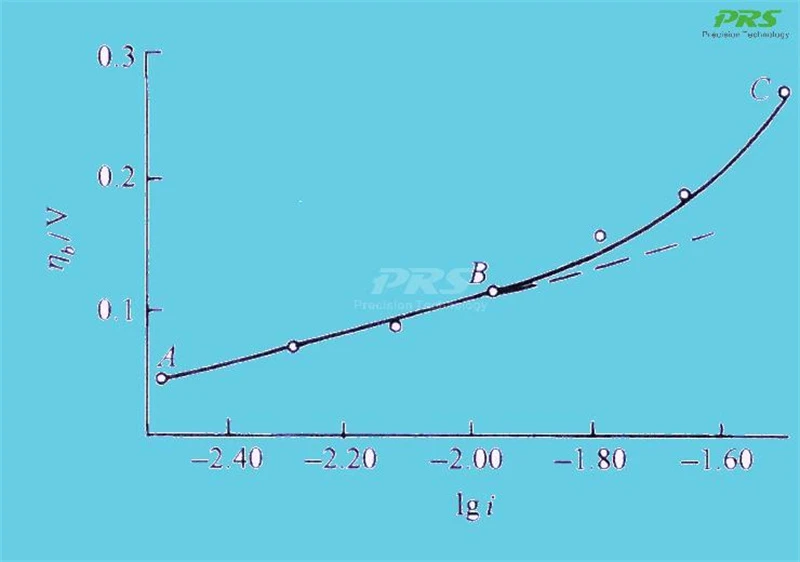
Fig. 6 Relationship between η and lg i
Point B marks the transition from electrochemical polarization to mixed control: above its current density a concentration gradient appears and the deposit may grow dendrites. B lies at 100 A/m², whereas electrorefining normally runs at 200–340 A/m². Production therefore already operates in the mixed-control region, which makes dense cathode copper difficult to obtain; the Tafel region must be extended and electrochemical polarization increased. This is exactly the role of additives: they shift the cathode potential so that nucleation and growth favour fine, smooth crystals.
Apart from a small amount of silver present as metal, the impurities in cathode copper exist as compound particles in the crevices of the copper. Lead, antimony, bismuth, sulfur and part of the silver enter by mechanical entrainment rather than by electrochemical discharge. The particle-size distribution of anode slime matches that of the impurities in the cathode, both being extremely fine, so slime and suspended solids in the electrolyte have a decisive influence on cathode quality. Reducing suspended solids (cleanliness below 10 ppm after filtration) and increasing the density of the deposit both help cut mechanical contamination and improve cathode quality.
6. Key Operating Parameters and Energy Consumption
Current density normally means cathodic current density, the current per unit cathode area (A/m²). It is one of the most important techno-economic indices and a major factor in deposit structure: a low current density gives fine, adherent deposits, while a high one tends to give coarse, non-adherent and porous deposits and easy anode passivation. Before 2000 conventional electrolysis used 220–270 A/m²; today 280–340 A/m² is used.
Cell voltage has four components: Ece = (φan − φca) + El + Econ + Ep, namely the anode and cathode potentials, the electrolyte voltage drop and the contact drops within the cell. Between 220 and 300 A/m², each additional 1 A/m² raises the cell voltage by about 1 mV. Cells run at 0.2–0.4 V with a current efficiency of 90%–98% (95%–98% in Chinese plants); energy consumption rises as cell voltage increases or current efficiency falls, and cell voltage dominates because it varies over a much wider range.
Raising the electrolyte temperature lowers viscosity, helps floating slime settle, speeds up ion diffusion and reduces electrolyte resistance. Measured conductivity at 55 ℃ is about 2.5 times that at 25 ℃, and between 50 and 60 ℃ the resistance falls by about 0.7% for each 1 ℃ rise. Too high a temperature, however, increases steam consumption, accelerates evaporation and worsens working conditions, so 60–66 ℃ is normally maintained.
The electrolyte must circulate continuously to keep temperature and concentration uniform within the cells. The circulation rate depends mainly on the circulation pattern, current density, cell volume and anode composition; a high current density requires a higher circulation rate to limit concentration polarization.
During electrolysis the copper concentration keeps rising, by about 1.5%–2.0% of the amount dissolved from the anode, while impurities accumulate and the sulfuric acid concentration falls. To keep the electrolyte stable, an equivalent volume is bled from the circulation system to purification and replaced with fresh water and acid; the bleed is de-coppered and stripped of arsenic, antimony and bismuth to produce copper sulfate, crude nickel sulfate is recovered by crystallization, and the acid returns to the electrolysis circuit.


