


Anode Plate
Your Professional Anode Plate Supplier
Sichuan Precision Technology Co., Ltd. (PRS) is a professional engineering company with 20+ years of experience delivering copper plant solutions worldwide.You need more than just equipment. You need a solution that works from day one - and keeps working.Our vision is to make modern copper electrowinning (EW) accessible, scalable, and efficient for all mining operations worldwide.




why choose us
One-Stop Solution
We provide an end-to-end service that covers the entire project cycle—from engineering design, equipment manufacturing, quality inspection, and logistics coordination to on-site installation and commissioning—ensuring seamless control and consistent quality at every stage.
Rich Project Experience
Our team has successfully delivered a wide range of copper EW (Electrowinning) projects with capacities from 3,000 to 50,000 TPA. These projects span multiple countries and operating environments, giving us deep industry expertise and proven technical solutions.
Customized Design
Each project is tailored to local environmental conditions, ore characteristics, production targets, and customer-specific requirements. We provide optimized engineering layouts, equipment configurations, and process flow designs to maximize efficiency and long-term operability.
After-sales Support
We offer comprehensive after-sales service, including 24/7 technical support, remote troubleshooting, timely spare parts supply, and on-site service when required, ensuring reliable operation and minimal maintenance interruptions.

High mechanical strength:
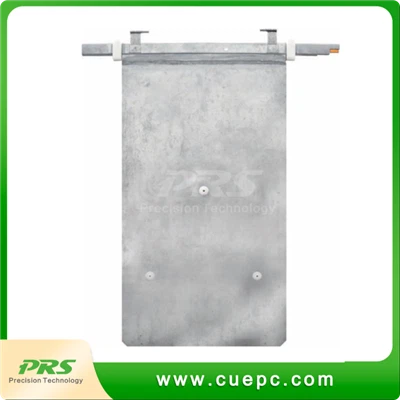
Anode plates are usually thicker, have higher mechanical strength and durability, and are suitable for occasions that need to withstand greater mechanical stress.
Easy to clean and maintain:
The smooth surface structure makes it difficult for anode plates to accumulate sediments during use, making cleaning and maintenance easier.
Uniform current density:
Solid anode plates can provide uniform current density and are suitable for some electrochemical reactions with higher requirements.
Technical Parameters
|
Item |
Specification |
|
Material |
Pure Lead / Pb-Sn-Ca / Pb-Sb / Customized |
|
Structure |
Fence-style grid with reinforced frame |
|
Thickness |
4–6 mm or customized |
|
Height |
≤ 1500 mm |
|
Width |
≤ 1000 mm |
|
Welding Method |
Fusion or Lead-burning |
|
Application |
Copper / Zinc / Nickel / Manganese Electrowinning |
|
Surface Finish |
Bright or matte, no visible cracks or defects |
How It Anode Plate Works
The anode plate is the core component of the electrostatic precipitator, and the acceptance criteria of the anode plate: straight, high strength, strong rigidity, and not easy to twist. The electrolytic anode plate is composed of anode hanging lugs, transition row, and main board. It is characterized by that the transition row is made of tin, silver, cobalt, silicon, antimony, and lead, and the main board is mixed with calcium, aluminum, silver, tin, and lead in a certain proportion. , In addition, trace rare earth elements are added, and they are produced by dissolving, mixing, casting, cold pressing, shearing, and stamping. Good anti-corrosion performance, used for electrolytic manganese.
A high-voltage electric field is formed between the cathode wire of the anode plate connected to the high-voltage DC power supply and the grounded anode plate. Due to the corona discharge at the cathode, the gas is ionized, and the negatively charged gas ions move toward the anode plate under the action of the electric field force. When the medium collides with the dust particles, the dust particles are negatively charged.Under the action of the electric field force, the charged dust particles also move toward the anode. After reaching the anode, they release a negative charge, and the dust particles are deposited on the anode plate. The purified gas is discharged out of the dust protector.
Choose TA1 grade titanium base material, ensuring a smooth, defect-free surface without scratches, peeling, cracks, or layering.
Machine the selected titanium substrate to meet customer specifications.
Anneal and level the titanium base at 600°C.
Annealing results in a dense titanium oxide layer on the surface, which is mechanically polished to reveal the metallic luster.
Etch the titanium substrate in 10% oxalic acid at a mild boiling state for 10 hours to remove the surface oxide layer.
Configure the precious metal solution according to the customer’s specified anode environment.
Inspect the acid-etched titanium substrate for a uniform gray surface texture, then apply the precious metal solution by hand. Sinter the coated substrate at a set temperature and allow it to cool to room temperature before applying the next layer, repeating until 18–22 layers are applied.
Upon completing the sintering process, perform a lifespan test on the batch sample, and, if approved, package and ship the finished product.

Aluminum Production
In aluminum smelting, anode plates are central to the electrolytic process that converts alumina into aluminum. Modern anodes are designed to withstand high temperatures and corrosive environments, reducing downtime and maintenance costs.
Electrochemical Energy Storage
Battery technology, especially lithium-ion and emerging solid-state batteries, relies on high-quality anode plates for enhanced performance.
Wastewater and Effluent Treatment
Anode plates are used in electrocoagulation processes to treat industrial wastewater. They help remove contaminants such as heavy metals, oils, and organic compounds.
Electroplating and Surface Finishing
Electroplating relies on anode plates to deposit metals onto various substrates, providing corrosion resistance and aesthetic appeal.
Chemical Synthesis and Electrolysis
In chemical manufacturing, anode plates facilitate electrolysis for producing chemicals like chlorine, caustic soda, and hydrogen. Advances in electrode coatings have improved efficiency and lifespan, reducing downtime.
custom made
Custom Plate Dimensions
Clients often need the stripping system tailored to non-standard plate lengths or thicknesses.
Automation Preference
Some prefer fully automated lines including stacking and reject handling, while others opt for budget-friendly semi-automated versions.
Copper Sheet Handling
Preventing copper bending or tearing during separation is critical.
Installation Space
Available plant floor area may restrict layout; flexible modularity is often requested.
Packaging & Shipping
Customs Clearance & CO
With rich experience in export documentation, we can quickly process Certificates of Origin and ensure a smooth customs declaration process.
Steel Frame Packaging
All anodes are packed in custom steel frames to secure every piece during transit, minimizing the risk of damage from rough handling at ports.
Efficient Loading
We support sea, road, or rail transportation depending on your project's location.
FAQ