


For managers operating copper electrowinning (EW) plants, the anode is far more than a simple spare part. It serves as the core foundation of the entire electrowinning process. Anode performance directly governs energy consumption, cathode copper purity, operational uptime, and ultimately, the plant's overall profitability. While the basic structure of lead alloy anodes is straightforward, fine design details are what separate average, short-lived units from reliable, high-efficiency ones.
At PRS, high-performance anodes are not achieved through post-production adjustments but are precisely engineered from the initial design phase. With decades of metallurgical research and field operation experience, we have refined five non-negotiable design criteria that enable our lead alloy anodes to deliver superior stability, efficiency, and service life.
1. Precision Alloy Formulation: The Metallurgical Foundation
The selection and proportion of alloying elements determine the fundamental performance of an anode. Pure lead plates cannot withstand the harsh high-acid and high-oxidation environment of electrowinning cells and suffer from rapid corrosion and premature failure. Our premium anodes adopt a multi-element Pb-Ca-Sn (Lead-Calcium-Tin) alloy system, further optimized with strontium and other trace elements to overcome the limitations of pure lead materials.
Core Function: Calcium and tin facilitate the formation of a hard, dense, and highly conductive lead dioxide (PbO₂) protective layer during operation. This stable layer supports efficient oxygen evolution reactions and effectively shields the underlying lead substrate from excessive corrosion, stabilizing cell conditions and extending anode service life.
Our Technical Advantages: Our proprietary alloy formula ensures uniform distribution of all elements across the entire plate. This delivers consistent electrochemical performance throughout the anode surface, eliminating localized corrosion and uneven performance degradation. Anodes built with this formulation achieve a stable service life of over 4–5 years with minimal cell voltage fluctuation, effectively reducing long-term energy costs.

Experimental and Operational Test Data
We conducted a series of comparative tests to verify the optimal tin content and its impact on anode performance. The key test findings are summarized below:
In terms of anode potential, the value gradually decreases as tin content rises. Tin reduces oxygen ion generation and accelerates the formation of high-quality PbO₂ films. Additionally, slight tin dissolution optimizes the porosity of the anode surface film, inhibiting the formation of high-impedance PbO and PbSO₄ deposits and further improving film conductivity and stability. Anode potential plateaus at a tin content of 1.2%–1.4%, with no further noticeable performance improvement.
In terms of cell voltage and electrochemical reversibility, the Pb-Ca-1.2%Sn anode delivers the lowest cell voltage and the best overall reversibility, while the Pb-Ca-1.4%Sn anode exhibits relatively lower overpotential with excellent comprehensive performance.
Performance Parameters of Anodes with Different Tin Contents:
|
Anode Alloy Formula |
a/v |
b/v |
Current Density (A·cm-2) |
|---|---|---|---|
|
Pb-Ca-0.6%Sn |
1.3521 |
0.6615 |
0.904×10⁻² |
|
Pb-Ca-0.8%Sn |
1.30 |
0.6451 |
0.966×10⁻² |
|
Pb-Ca-1.0%Sn |
1.3196 |
0.6414 |
0.876×10⁻² |
|
Pb-Ca-1.2%Sn |
1.2483 |
0.6396 |
1.12×10⁻² |
|
Pb-Ca-1.4%Sn |
1.2758 |
0.5986 |
0.739×10⁻² |
Optimal Alloy Ratio Conclusion: Based on comprehensive tests on anode potential, cell voltage, operational stability, and energy efficiency, a tin content of 1.2%–1.4% is identified as the most reasonable range.
Our standardized recommended alloy composition: Ca: 0.06–0.08%, Sr: 0.04–0.05%, Sn: 1.2–1.4%, with lead accounting for the remaining proportion.

2. Robust Joint Integrity: Patented Trapezoidal Bayonet Weld
Lead alloy anode plates are heavy and endure continuous mechanical stress during long-term electrolysis operation. Weld failure, delamination, and poor conductivity at the joint between the lead blade and copper conductive beam are the most common causes of conventional anode breakdowns. To solve this industry pain point, we adopt a patented trapezoidal bayonet seamless welding technology.
Core Advantages: The trapezoidal structural design creates a tight mechanical interlock between the lead plate and copper beam before welding, eliminating all lateral and vertical displacement risks. The subsequent seamless welding process achieves complete metallurgical fusion of the two metals, forming an integrated structure rather than a superficial joint.
Operational Benefits: The ultra-high-strength weld completely prevents plate bulging, separation, and cracking during operation. The integrated structure ensures stable electrical conduction, minimizes voltage drop, and maintains full structural and electrical integrity throughout the anode's entire service life, adapting to long-term continuous production.


3. Optimized Hydrodynamics: Strategic Hole Layout for Better Electrolyte Flow
High-performance anode design focuses not only on material and structural strength but also on electrolyte flow management. Most conventional anodes only install insulators at three points: two bottom ends and the center. We upgrade this design with additional strategically positioned holes to stabilize electrolysis conditions significantly.
Design Purpose: The reserved holes are designed for insulator pins to fix the anode position and prevent short circuits between anodes and cathodes. The optimized multi-hole layout further improves electrolyte flow paths and accelerates circulation inside the cell.
Operational Benefits: Uniform electrolyte flow stabilizes copper ion concentration on the cathode surface, enabling even copper deposition and eliminating nodules and dendrite defects. Improved fluid circulation also efficiently dissipates heat and removes oxygen bubbles, ensuring smoother electrolysis and producing higher-purity, more consistent cathode copper.

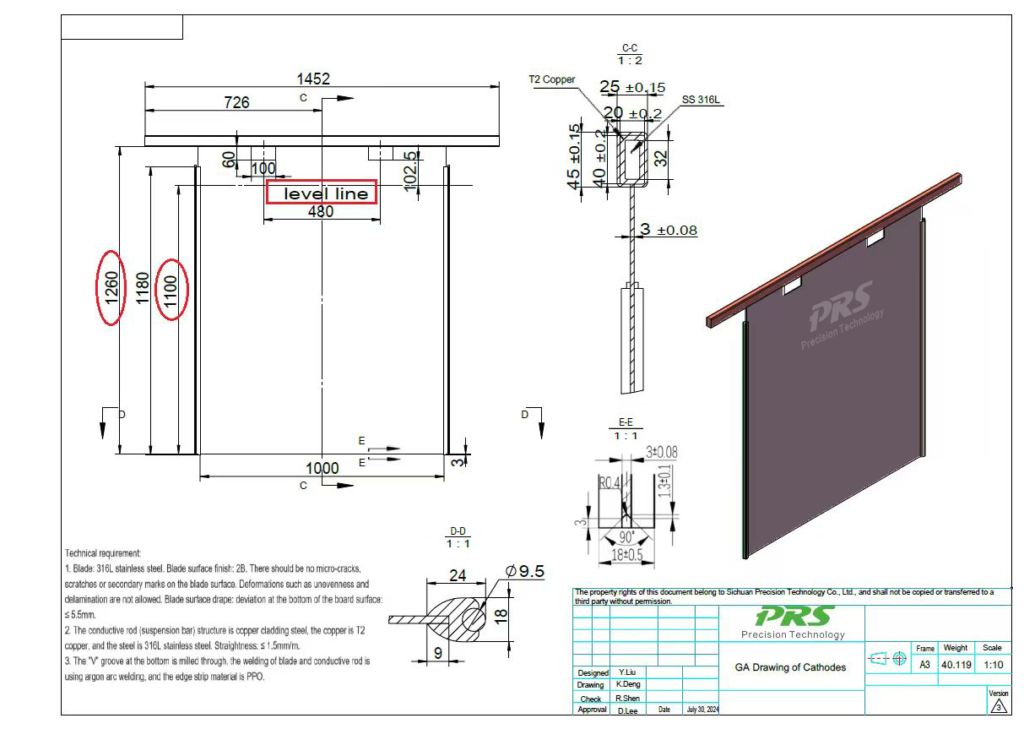
4. Precise Dimensional Matching: Anode-Cathode Size Ratio Control
The dimensional ratio between anodes and cathodes is a critical parameter for high-quality, flat cathode copper production, rather than a random specification. Strict size difference control is essential to meet market-grade copper standards.
Our standardized design specifies that the lead alloy anode plate is 30mm narrower in width and 35–40mm shorter in height than the stainless steel cathode plate.
Design Principle: This precise dimensional difference controls current density distribution at the cathode edges. Oversized anodes cause excessive edge deposition, forming rough, uneven "ear edges" on cathode copper, which require secondary processing and affect finished product packaging and quality grading.
Operational Benefits: The optimized size matching produces flat, dense, smooth-edged cathode copper with no secondary finishing required. The finished products stably meet LME Grade A copper standards and deliver higher market value.

5. Critical Zone Protection: Controlled Liquid Line-to-Weld Distance
The area around the electrolyte liquid line is the harshest working zone for anodes, subject to alternating immersion and air exposure that accelerates corrosion and causes premature failure. The vertical distance between the top weld and the operational liquid line is a key determinant of long-term anode durability.
- Standardized Design Parameter: We strictly control the weld-to-liquid-line distance at 150mm±50mm.
- Design Value: This specification keeps the critical weld structure completely away from the splash zone and high-oxidation corrosion areas, preventing weld corrosion, oxidation, and damage from the source.
- Operational Benefits: It fully protects the core connecting structure of the anode, sustaining structural integrity and electrical stability for years, reducing failure rates, and extending overall equipment service life.
Engineering Precision Drives Sustainable Operational Value
PRS anodes are not merely standard industrial components but performance-optimized solutions built on decades of metallurgical expertise and global field operation experience. Every design detail is verified by experimental data and practical plant conditions to deliver tangible operational improvements:
- Extended Service Life: Reduces downtime and frequency of anode replacement, cutting maintenance costs.
- Lower Operational Costs: Stabilizes cell voltage and improves conductivity to reduce power consumption.
- Higher Cathode Purity: Eliminates lead contamination risks and consistently produces Grade A copper.
- Enhanced Operational Reliability: Minimizes unexpected failures and ensures stable, predictable production schedules.
If you are looking to upgrade your existing anode equipment, reduce energy consumption, and improve cathode copper quality, our engineering team can provide customized solutions tailored to your specific cellhouse conditions to help your plant achieve cost reduction and quality upgrading.


