


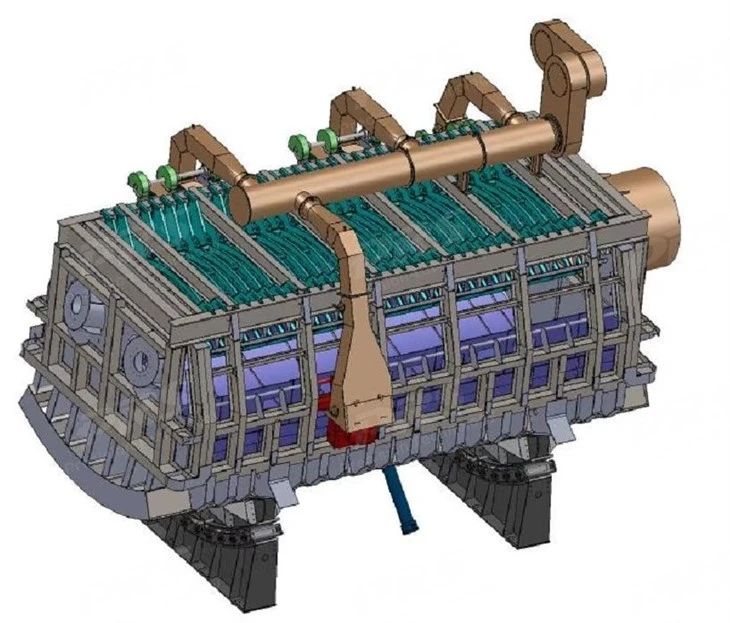


Tilting Furnace For Copper Refining
Product Overview
Hydraulic Tilting Furnace for Full-Spectrum Copper Pyrometallurgy
The hydraulic tilting furnace is a high-flexibility copper fire refining equipment developed on the basis of traditional stationary reverberatory furnaces. It adjusts the furnace body inclination through a hydraulic drive system to match the process requirements of charging, oxidation, reduction, slagging and pouring, and is widely used in anode copper production, scrap copper refining and continuous copper rod casting lines.
Different from stationary furnaces that rely on manual operation for all links, the tilting furnace realizes position matching of each metallurgical stage through furnace body tilting, which reduces manual intervention in high-temperature operations, improves refining efficiency and operation safety, and reduces metal loss in slag discharge.

Working Principle & Process Stages
The defining characteristic of the Tilting Furnace is its ability to adjust its physical orientation to suit each metallurgical stage. This "Dynamic Positioning" offers benefits that stationary units cannot match:
The furnace body is supported by trunnions on both sides and driven by a hydraulic cylinder to tilt at a set angle. The whole refining cycle is completed in the following sequence:
- Charging & Melting
The furnace body remains horizontal. Blister copper, copper scrap or recycled copper raw materials are loaded into the furnace, and the end-mounted burner heats and melts the charge. - Oxidation Refining
The furnace body tilts about 15° to the air duct side, so that the fixed injection pipe is immersed to the set depth of the molten bath, and compressed air is injected to remove impurity elements such as iron and lead. - Reduction Operation
After oxidation, the furnace body adjusts to the reduction position, and reducing agent is injected through the fixed pipeline to adjust the oxygen content of molten copper to the casting standard. - Slag Discharge
The furnace body tilts to the slag port side, and the upper layer of slag is discharged by gravity, with less entrained copper and lower metal loss than manual skimming. - Pouring & Casting
The furnace body tilts slowly to the pouring lip side at a controlled speed, and molten copper is uniformly poured into the anode casting mold or continuous casting system. - Emergency Reset
In case of power failure or emergency, the furnace body can return to the horizontal position through the hydraulic redundancy system or gravity-assisted design to stop pouring and avoid molten copper spillage.

Core Structural Composition
- Steel Furnace Shell
Heavy-duty welded steel shell with high structural rigidity, supporting long-term thermal cycling operation. - Multi-Layer Refractory Lining
Graded lining structure composed of insulation layer, insulation bricks and high-alumina hot-face bricks, balancing thermal insulation performance and molten metal erosion resistance. - Hydraulic Tilting Mechanism
Dual-cylinder synchronous drive system with stepless speed regulation, supporting different tilting speeds for slag discharge and pouring, with angle locking and limit protection devices. - Fixed Refining Pipeline System
Integrated oxidation and reduction injection pipelines, which are immersed to the working depth with the tilting of the furnace body, avoiding manual pipe insertion operation. - Burner & Combustion System
End-mounted high-efficiency burner, compatible with natural gas, LPG, heavy oil and other fuels, supporting oxygen-enriched combustion configuration. - Flue Gas Collection Hood
Negative pressure suction hood is configured at the flue gas end to collect process flue gas in a closed manner and reduce workshop smoke diffusion. - Electrical Control System
Centralized control cabinet with tilting angle display, temperature monitoring and fault alarm functions.
Technical Specifications
| Item | Specification |
|---|---|
| Standard Capacity Series | 60T, 80T, 100T, 150T; custom capacity up to 200T |
| Tilting Drive | Dual-cylinder hydraulic synchronous drive |
| Maximum Tilting Angle | About 45° for pouring; about 15° for oxidation/reduction |
| Fuel Compatibility | Natural gas, LPG, heavy oil (oxygen-enriched combustion optional) |
| Refractory Lining | Three-layer graded structure: insulation layer + insulation brick + high-alumina hot-face brick |
| Control Mode | Centralized PLC control + on-site operation station |
| Flue Gas Control | Integrated negative pressure collection system |
| Installation Form | Fixed installation on concrete foundation |
Core Performance Advantages
- Automated Refining with Less Manual Intervention
Fixed injection pipeline works with furnace tilting, eliminating the need for manual insertion of oxidation/reduction pipes at high temperature, reducing labor intensity and operational risks. - Efficient Slagging with Low Metal Loss
Gravity-assisted slag discharge by tilting the furnace body achieves more thorough impurity removal and less entrained molten copper than manual skimming, which is more suitable for processing scrap copper with high impurity content. - Controllable Pouring & High Safety
Hydraulic stepless speed regulation controls pouring flow stably, which matches different casting rhythms. Equipped with emergency reset design to avoid molten copper spillage caused by power failure. - Wide Raw Material Adaptability
It can process blister copper, qualified copper scrap and recycled copper materials of different grades, and is suitable for both primary smelting plants and secondary copper recycling projects. - Stable Molten Copper Quality
The fixed immersion depth of the injection pipeline ensures uniform oxidation and reduction reaction, and the composition and temperature of molten copper are more stable than manual operation. - Good Environmental Performance
Closed flue gas collection with negative pressure reduces the diffusion of process smoke and dust, which is easier to meet local environmental emission requirements.
Comparison: Tilting Furnace vs. Stationary Refining Furnace
| Item | Tilting Furnace | Traditional Stationary Furnace |
|---|---|---|
| Pouring Control | Hydraulic tilting, stepless flow regulation | Manual tap-hole plugging, large flow fluctuation |
| Oxidation/Reduction | Fixed pipeline, automatic immersion operation | Manual pipe insertion, high labor intensity |
| Slag Discharge | Gravity-assisted tilting slagging, low copper loss | Manual skimming, high metal loss |
| Safety Level | Emergency reset design, less manual contact with high temperature | High-risk manual operation near high-temperature furnace mouth |
| Labor Requirement | Low, 1-2 operators for monitoring | High, requiring multiple skilled operators |
| Applicable Scenario | Medium and large-scale production lines with high requirements for efficiency and safety | Small-scale projects with tight budget and low output requirements |
For projects with limited budget and stable raw materials, you can refer to our Fixed Copper Refining Furnace for a more economical solution.
Application Scenarios
- Anode Copper Production: Provides stable high-purity molten copper for automatic anode casting lines
- Scrap Copper Refining: Processes 1# and 2# copper scrap into anode-grade molten copper for downstream electrolysis
- Continuous Casting & Rolling: Supplies stable molten copper flow for copper rod continuous casting and rolling lines
- Secondary Copper Recycling: Supports copper scrap recycling and remelting in non-ferrous metal recycling projects
Targeted Model Guidance
We have dedicated models for different application scenarios to match process requirements more accurately:
- For anode plate dedicated production lines: 30T Anode Copper Tilting Furnace
- For scrap copper recycling with high impurity content: Rotary Tilting Furnace for Copper Scrap
Matching Supporting Equipment
- Automatic Copper Anode Casting System
- Anode Preparation Machine
- Spent Anode Washing Machine
FAQ – Tilting Furnace for Copper Refining
Q1: What raw materials is the tilting furnace suitable for?
A: It is suitable for blister copper, qualified copper scrap and other copper-containing raw materials. It performs well especially for scrap copper with certain impurity content that requires frequent slagging and oxidation operations.
Q2: Can it be directly connected with a copper rod continuous casting and rolling line?
A: Yes. By adjusting the tilting speed and pouring flow, it can provide stable molten copper supply for continuous casting and rolling systems to meet the production rhythm of continuous lines.
Q3: How does the furnace ensure safety in case of power failure?
A: The hydraulic system is equipped with an emergency oil circuit or gravity-assisted reset structure. In case of power failure, the furnace body can slowly return to the horizontal position to stop pouring and avoid molten copper spillage.
Q4: What is the service life of the refractory lining?
A: Refractory life depends on operating intensity and raw material conditions. Under normal continuous production, the hot-face high-alumina bricks can be used for 8–12 months. Standardized maintenance and regular furnace condition inspection can effectively extend the service cycle.
Q5: How to select the appropriate furnace capacity?
A: Capacity selection is mainly based on daily output, single heat cycle time and downstream casting rhythm. You can provide your planned output and raw material conditions, and we will recommend a matching capacity scheme.
Hot Tags: tilting furnace for copper refining, China tilting furnace for copper refining suppliers, anode preparation machine
You Might Also Like


Send Inquiry